

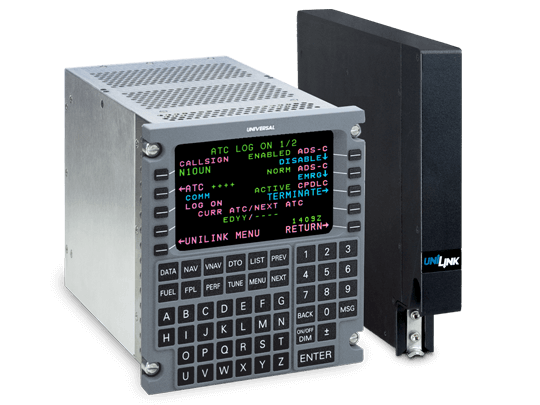
UniLink™ CMU
Communications Management Unit
UniLink Communications Management Units (CMU) provide superior operations with control of two-way air-to-ground digital communications between the pilot and the Air Traffic Controller (ATC). Combined with the Universal Avionics Satellite-Based Augmentation System (SBAS)–Flight Management System (FMS), the UniLink UL-800/801 CMU provides an opportunity to take full advantage of the safety and efficiency benefits that advanced data link capabilities offer.
Overview
Increasingly congested skies demand a data link system with optimum management of two-way air-to-ground communications. The Universal Avionics UniLink UL-800 and UL-801 Communications Management Unit (CMU) provides superior operations and control of digital communications between the pilot and Air Traffic Controller (ATC) in the exceedingly complex Communication, Navigation, Surveillance (CNS) Air Traffic Management (ATM) environment. Developed in full compliance with DO-178B Level C guidelines, the UniLink UL-800/801 CMU also meets FANS 1/A+ standards.
A Platform for the Future CNS / ATM Environment
Fully compliant with the FANS 1/A+ mandate affecting operators in the North Atlantic Track System (NATS) and some Pacific Ocean routes, the UniLink UL-800/801 includes Controller-Pilot Data Link Communications (CPDLC) and Automatic Dependent Surveillance-Contract (ADS-C) functionality. With these FANS capabilities, operators gain preferred routing and options for altitudes with more favorable winds when in the NATS. Preferred routing provides a lower fuel burn and shorter station-to-station times, helping operators gain efficiencies that save fuel, time and money.
Provisioned for the upcoming Link 2000+ Programme mandate, the UniLink UL-800/801 enables operators to proactively equip for this and the FANS requirements while increasing the aircraft’s utility. The entire NATS between FL350 and FL390 requires FANS 1/A capability.
The UniLink UL-800/801 is also provisioned for the Aeronautical Telecommunications Network (ATN), a future internetwork architecture designed by the International Civil Aviation Organization (ICAO). This network will allow ground / ground, air / ground, and avionic data sub-networks to interoperate by adopting common interface services and protocols based on the International Organization for Standardization (ISO) Open Systems Interconnection (OSI) Reference Model.
Flight Information Services
Flight Information Services are available through the VHF radio or a capable approved Inmarsat Packet Mode Data or Iridium Short Burst Data (SBD) SatCom system.
- Pre-departure clearance (CPDLC DCL Operational Airports)
- Oceanic clearance
- D-ATIS
- TWIP
- Pushback clearance
- Expected taxi clearance
Data Link text messaging
UniLink’s independent menu-format software integrates seamlessly with the FMS and provides easy access for sending and receiving data. UniLink affords data link opportunities for:
- Air to ground text messaging via service provider, accessed via internet, fax or email
- Ground to air text messaging via service provider, accessed via internet
- Automatic position reporting (aircraft tracking via service provider)
- ETA updates
- Text weather information including TAF, METAR, SIGMETS, and winds aloft
Routing
The UniLink UL-800/801 supports Air Traffic Services (ATS) Facilities Notification (AFN), allowing the aircraft and the ATS provider to exchange addresses as well as information about the FANS application supported. Communications may be routed using compatible Inmarsat or Iridium satellite systems and via the ACARS high-speed VHF Data Link (VDL) Mode 2 network when within range of these facilities. For increased installation flexibility, the UniLink UL-801 model features an internal VHF Data Radio (VDR) that saves weight and space. The UL-800 supports interface to an external VDL Mode 2 compliant VDR.
Airline Operations
The UniLink can downlink aircraft-acquired data for maintenance and operational analysis including engine data from a Central Maintenance Computer. Meteorological data collection and reporting is supported, as well. UniLink’s database-driven user interface and message set is easily customized to match airline operational requirements and is uploaded into UniLink without affecting product software or certification status.
Interfaces
The UniLink UL-800/801 supports Universal Avionics FMS installations, Multi-Function Control Display Unit (MCDU) and ARINC 702A communication protocol. Support for ARINC 739 interface for use with other capable MCDU display units is standard on UniLink. In installations where FANS approval is sought, a Cockpit Voice Recorder (CVR) capable of recording data link messages is required as part of the system installation. The UniLink UL-800/801 supports transmission of AOC, CPDLC and FANS data link recording, interfacing with the Universal Avionics CVR or Cockpit Voice and Flight Data Recorder (CVFDR), or other capable systems, via an ARINC 429 data bus.
Field-Loadable Databases
The customer database driven user-interface and message set can be customized to match airline or business operational requirements. UniLink uses three databases: customer (which includes the Aeronautical Operational Control (AOC) database), geographic and ATC. Databases are installed by Universal Avionics and also in the field by customers using a Universal Avionics data loading DTU-100 or Solid-State Data Transfer Unit (SSDTU). UniLink enables application software to be loaded in the field without removal of the equipment from the aircraft installation.
- Provides reliable digital communication between the aircraft and the ground (ground to air and air to ground text messaging)
- Meets the FANS 1/A+ mandate
- ACARS functions including Out–Off–On–In (OOOI) and Airline Operational Control (AOC)
- Auto aircraft position reporting and aircraft tracking
- AOC messaging, FANS message handling and uplink / downlink messages from peripheral systems
- FMS Flight Plan uplink from service provider
- Uplink forecast winds
Specifications
Functional
- Compliant with ARINC standards 618, 619, 620, 622, 623, 724B and 758
- External Interfaces
- ARINC 750 VHF Radio (UL-800 only)
- ARINC 741 SatCom (supports FANS 1/A+ remote oceanic)
- Iridium / Inmarsat SatCom Telephony
- ARINC 604 Central Maintenance Computer
- ARINC 740 / 744 / 744A Printer
- Serial Printer
- Universal Avionics Ethernet dataloader SSDTU or DTU-100
Hardware
- Size: Unit Size: 1.1 in. W x 7.6 in. H x 15.2 in. D
- Weight: 3.3 lbs. (UL-800), 4.54 lbs. (UL-801)
- Mounting: 1 MCU Rack
- Internal VDR Radio (UL-801 only): 20 watt; 118-137 MHz, 25 kHz spacing
- Antenna: 50 ohm passive VHF, 118-137 MHz
- Configuration Module
- Built-in Test Equipment (BITE)
Inputs/Outputs
- ARINC 429: 16-input / 8-output
- RS-422 / 232: 6-input / 6-output
- RS-232 Diagnostics Port: 1-input / 1-output
- Ethernet: 3 10 / 100 Base-T
- Discretes: 10-input / 14-output
Power
- 28 VDC nominal
- UL-800: 15 watts typical
- UL-801: 96 watts typical
FAA TSO/ETSO
- C160 VDL Mode 2 Communications Equipment
RTCA Documents
- Hardware: DO-160F Environmental Categories
- Software: DO-178B Level C
System Architecture
Compatible Integrations
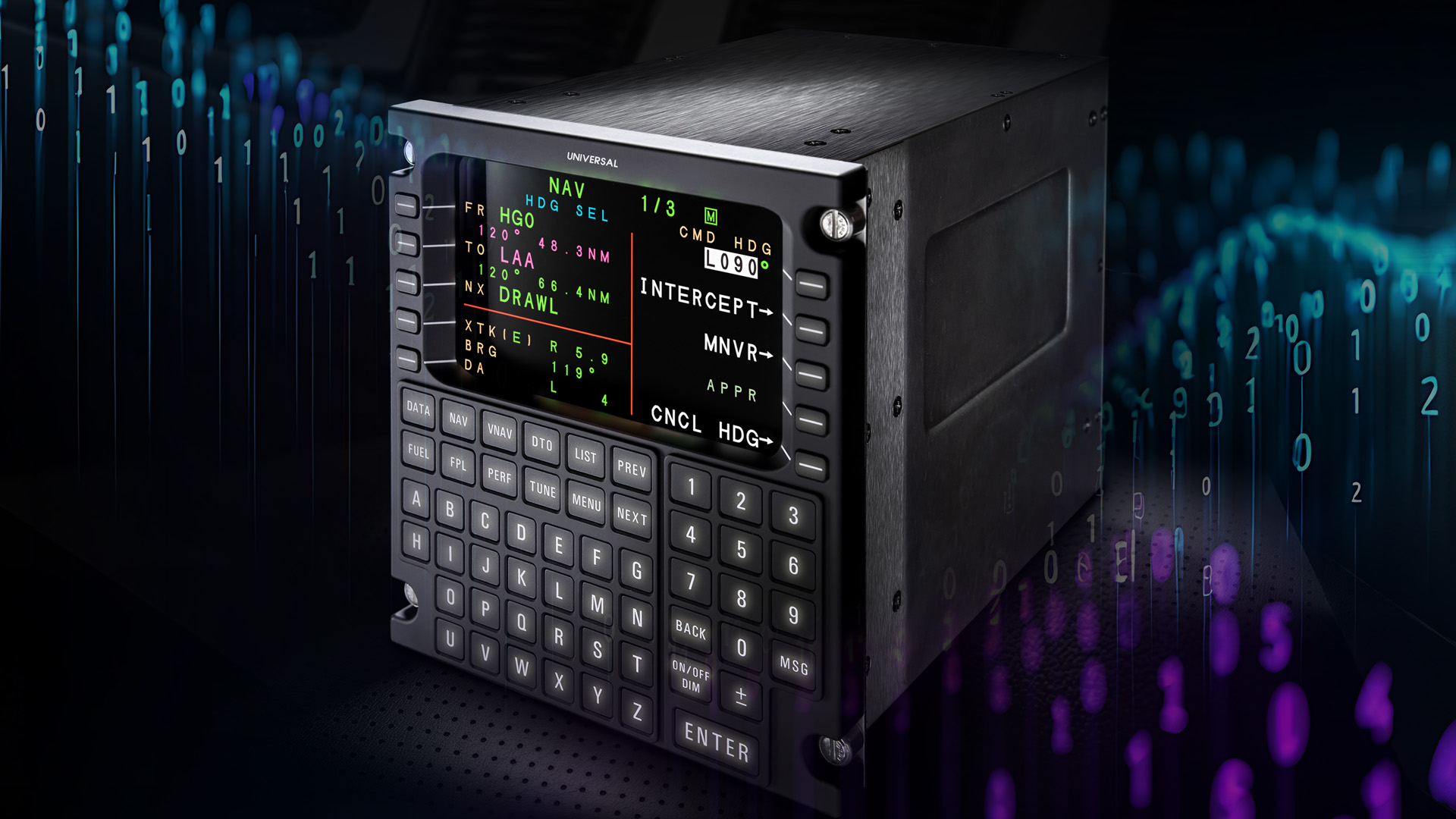
UNS-1Fw Universal FMS
Flight Management System with Satellite-Based Augmentation (SBAS) that integrates with next-gen upgrades for Data Comm and LPV.

InSight® Display System
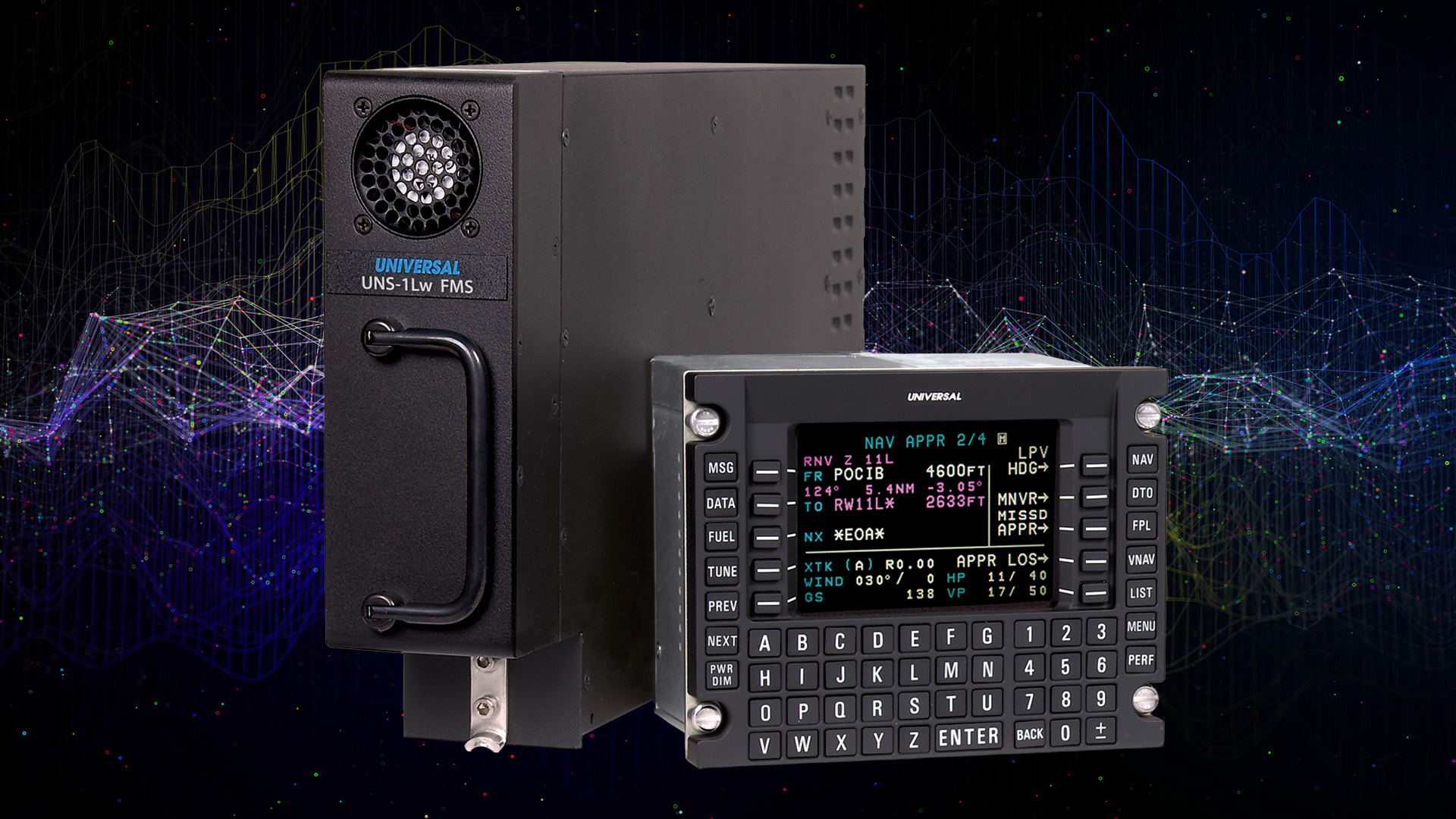
UNS-1Lw Universal FMS
Flight Management System with Satellite-Based Augmentation (SBAS) that integrates with next-gen upgrades for Data Comm and LPV.
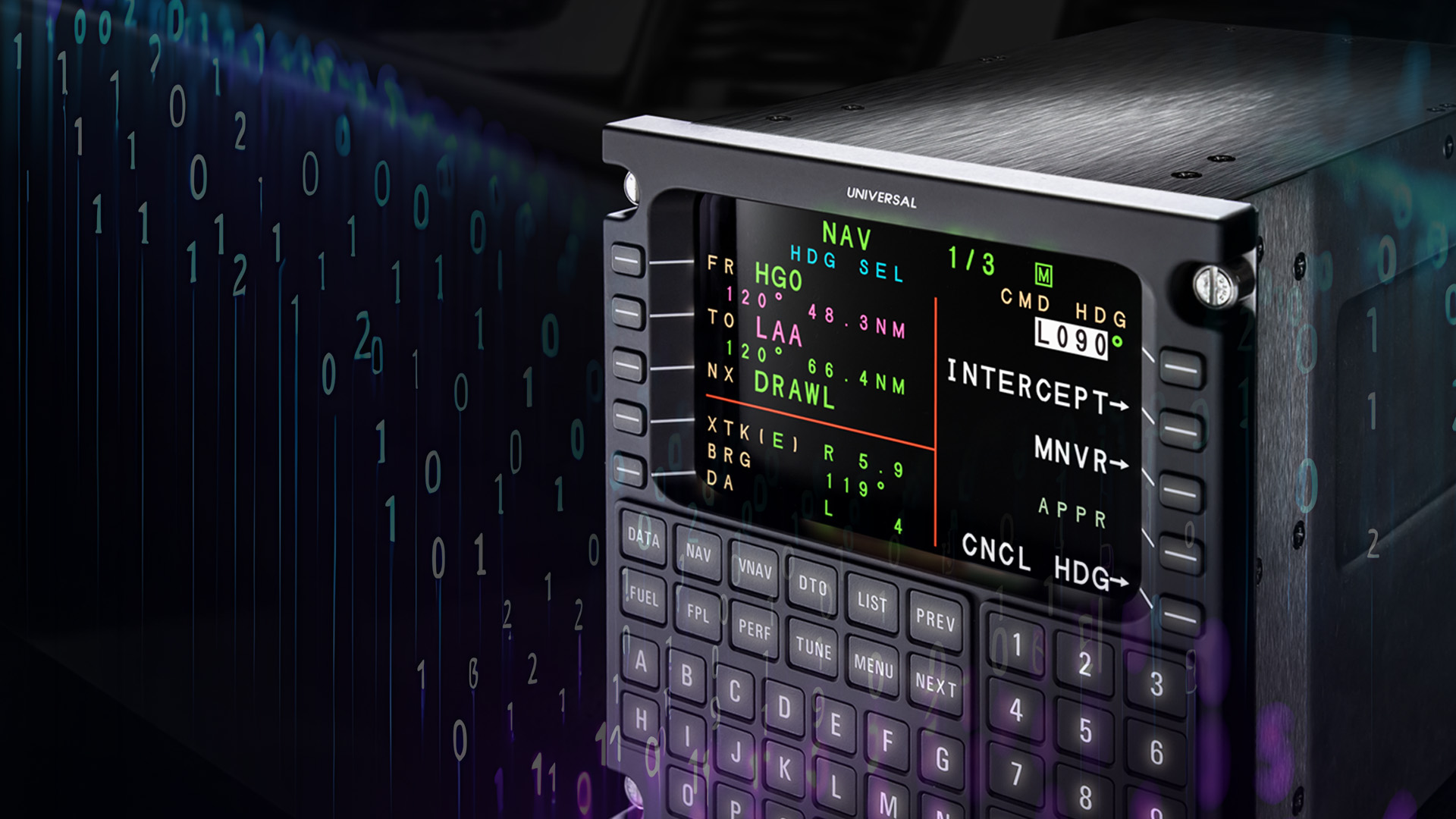
UNS-1Ew/UNS-1Espw Universal FMS
Flight Management System with Satellite-Based Augmentation (SBAS) that integrates with next-gen upgrades for Data Comm and LPV.
Resources
UniLink™ Brochure Download PDF
Data Comm with UniLink™ CMU Download PDF
Understanding Data Comm Systems with FANS 1/A+, CPDLC DCL, and ATN B1 Download PDF
UniLink™ Trainer Brochure Download PDF
Solutions for NextGen and Beyond Download PDF